



[ad_1]
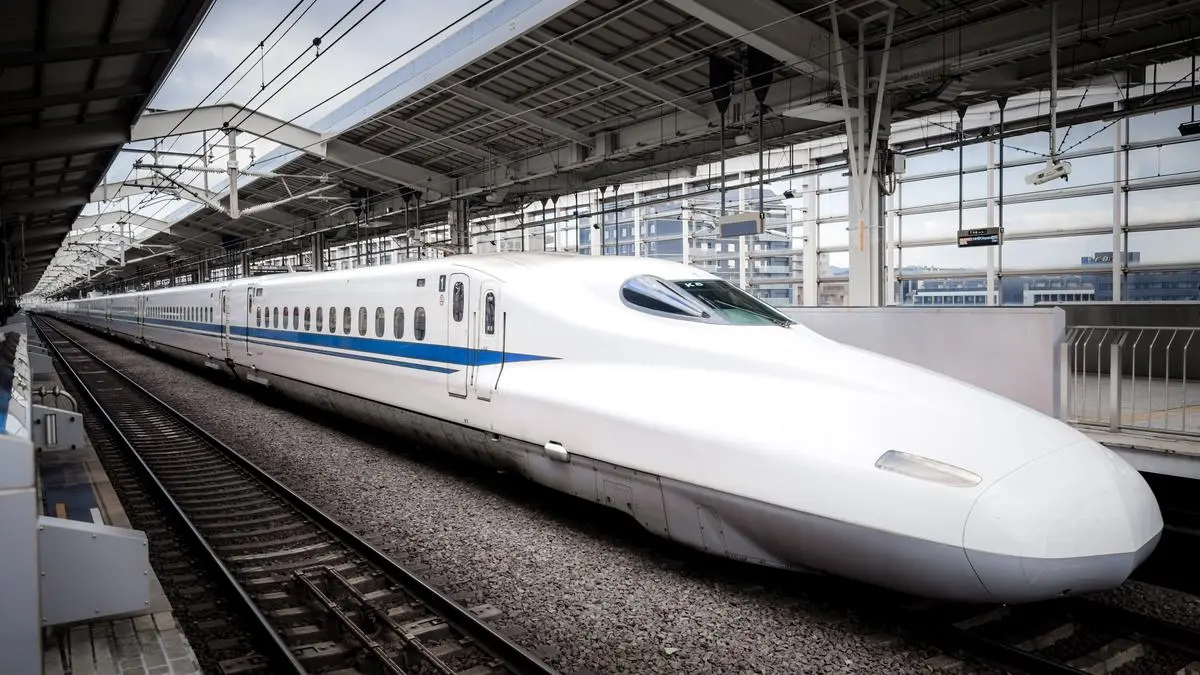
HSR being developed is wedded to Japanese trains, and we should have been prepared for hard negotiations
| Photo Credit:
yongyuan
High-Speed Rail (HSR) are networks that operate at higher speeds than conventional rail services, usually at 250 kmph or more. HSR systems bring down travel time between cities, connecting key economic hubs, boosting economic growth, and supporting healthy urbanisation in areas near major city conglomerates with huge employment opportunities. It is one of the cleanest and greenest modes of public transport, with examples around the world where HSR has replaced air travel.
No longer the preserve of developed countries like Japan, France, Spain, or Germany, China today boasts the world’s largest network at 46,000 km, and even countries like Morocco, Indonesia, and Uzbekistan have it. It is also in the pipeline in other middle-income countries like Vietnam, Malaysia, and Iraq. The only notable exception is the US, where powerful road and air lobbies block the introduction of HSR.
We debated ad nauseam whether HSR is good for India since 1990s, quite omitting to heed global experience indicating that India could hardly be an exception. A fit case for comparison is China, with somewhat similar demography and distances; 10 billion people travel every year there as against about eight billion in India, and they have built the largest high-speed rail network in the world.
Delays galore
Thanks to Prime Minister Narendra Modi, all procrastination was put to rest, and in 2015, the 508 km Mumbai-Ahmedabad HSR project was sanctioned at estimated cost of approximately ₹98,000 crore, of which the Japan International Cooperation Agency (JICA) would fund 80 per cent, and the rest by central and State governments.
It has since been a disappointing story. Completion, projected for 2022, has been pushed beyond 2030, with full operation expected only by 2033, and the cost escalating to around ₹2 lakh crore. The delay and cost escalation are attributed by the National High-Speed Rail Corporation Ltd (NHSRCL), the PSU of Indian Railways (IR) entrusted with executing the project, to poor land acquisition progress in Maharashtra during the previous regime, Covid-19, the alteration to build only on viaducts due to ground conditions, etc.
Added to that is the briefing by NHSRCL to the Parliamentary Standing Committee in March, that it was not possible to give a reliable estimate of timeline and cost — despite nearly 50 per cent of the civil infrastructure being complete.
It is clear that the project suffers from drift. It is learnt that the rolling stock procurement could not be finalised due to exorbitant prices quoted by Japanese companies. IR reportedly appointed an independent committee of consultants to review the quote, which concluded it was indeed exorbitant, but the Japanese side did not budge.
This should not have come as a surprise, as a similar situation arose during the procurement of locomotives for the Japanese-funded Western DFC, and IR had then decided not to source from Japan. This case, however, is more difficult, as the HSR being developed is wedded to Japanese trains, and we should have been prepared for hard negotiations.
BEML effort
IR has decided to go ahead with the development of its own trains by placing orders on BEML. A jump from indigenous capability of 180 kmph trains to 280 kmph ones is hardly the ideal way for development which should be calibrated in step-by-step progress.
In any case, even if the project succeeds — which we hope it will — the trains would still be run at a sub-optimal level of 250 kmph against the designed civil infrastructure for 320 kmph.
In the middle of this imbroglio, one hears that Japan will provide two Shinkansen trains at no cost by 2026, which will be used to collect crucial data especially regarding India’s environmental challenges, such as high temperatures and dust. This, however, merely adds confusion instead of offering any hope of resolution.
A similar roadblock is the issue of high price of the signalling system. NHSRCL decided to tender for an alternative system to be used till the latest version of Japanese train arrived later. Alstom-L&T and DRA-Siemens JVs are the two bidders, and it would be interesting to see how this contract is awarded and executed.
Even as the Mumbai-Ahmedabad project languishes, the net is spread wide with never-ending surveys for multiple routes. It is time to be more decisive and immediately sanction two shorter stretches, like Chennai-Bengaluru and Delhi-Amritsar, and complete them in six to seven years.
One would think that negotiating a better deal with the Japanese is still the best option. The HSR projects are crucial, and while operations may somehow commence by 2030, there is a need to handle the issue in a more meaningful and committed manner.
The writer is Retd. GM/Indian Railways and leader of Vande Bharat project
Published on May 13, 2025
[ad_2]
Source link


