



[ad_1]
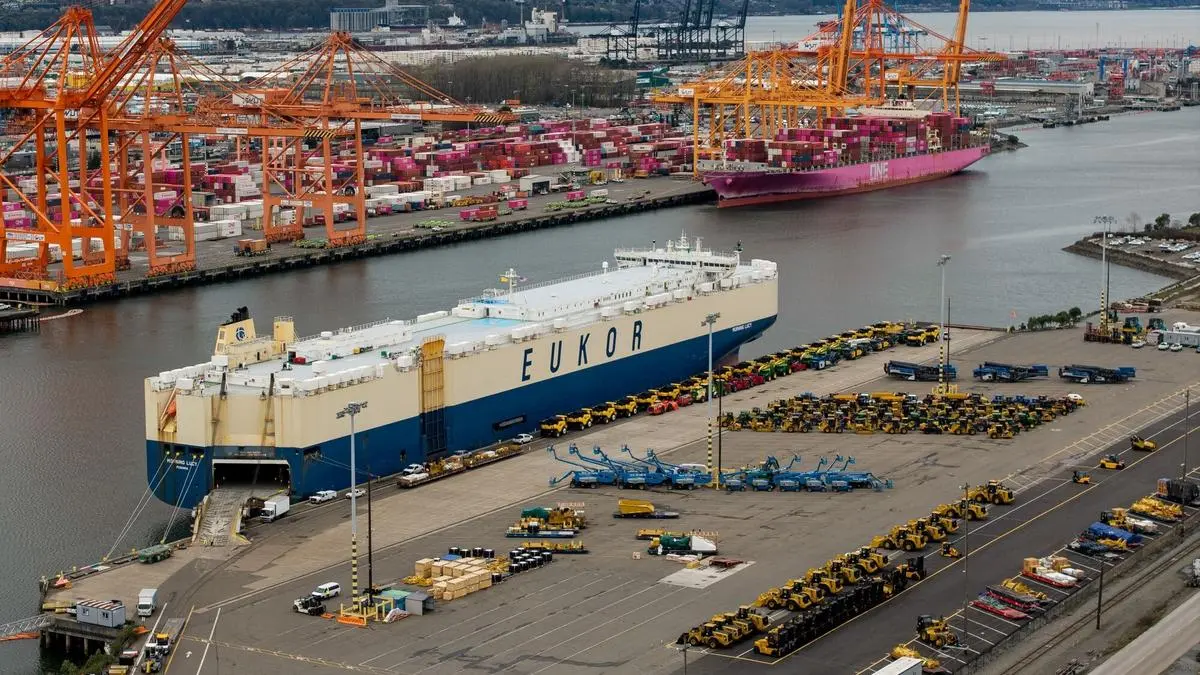
Sudden policy steps that disrupt global markets could undermine confidence in the US financial system, and even the dollar
| Photo Credit:
DAVID RYDER
The Donald Trump administration has thrown the global economic system into a tizzy. Trump has held off tariffs for three months, with the exception of China, after the latter dumped US Treasures on Wednesday and set off an alarming spike in yields. The US government, or at any rate the President and his close advisors, wants the dollar to depreciate but in a manner of its choosing. It also wants to reorder the world’s trading and production architecture, taking it back to what it was maybe four or more decades ago, when its manufacturing prowess was significant.
So, what is Trump’s game-plan? To get there, it is important to go into some history. Almost a century of US economic dominance has been driven by two major eras:
The Bretton Woods Accord with 44 allied nations in 1944 created a stable global economic system after World War II. Countries agreed to peg their currencies to the US dollar (which in turn was convertible to gold), and dollar became the reserve currency of the world. Many countries signed security accords that bought US military protection in exchange for buying American goods and services. As a result, US manufacturing industries flourished as American made goods were in high demand during the post-war rebuilding era across the globe.
The Reagan-Thatcher (neo-liberalism) era ushered in the second wave of prosperity. This philosophy favoured free markets, deregulation and opening up of the world economy. The world followed suit by removing trade barriers, cutting tariffs, and liberalising capital flows. Global trade expanded rapidly with more countries integrating into the world economy. Since the dollar was no longer pegged to gold, its supply as well as value massively increased giving the US unprecedented buying power. However, in the rush to maximise profits, US firms chased low wages and weak regulations abroad leading to collapse of entire industries from textiles to steel to electronics. The result was massive deindustrialisation across the American landscape. This led to serious trade deficits with the rise of Japan and China as the major exporters not only to the US but also the world.
That brings us to the Trump era. He truly believes that tariffs as the only way to correct the serious trade imbalances and unfair treatment meted out by major trading partners. He has been consistently talking about tariffs for more than 20 years. US manufacturing revival was a major poll promise in both his campaigns. Additionally, Trump’s economic advisors no longer view manufacturing revival a trade issue but a national security issue. They point to the serious supply chain disruptions that happened during the pandemic, leading to high inflation and a recession.
Mar-a-Lago accord
Considering these issues, the administration is now throwing the dice to fundamentally reset the world economic order to re-assert the US economic and military/political dominance. Trump wants to cement his legacy by orchestrating a revised contract with the world, termed the ‘Mar-a-Lago accord’. The plan involves 4 major components:
Impose significant tariffs: The objective is to protect domestic industries and reduce trade deficits. In January 2025, the US trade deficit reached a record high of $131.4 billion, a 34 per cent increase from December 2024’s revised deficit of $98.1 billion. Already, 50 different countries have reached out to Trump’s office to negotiate tariffs. It is worth seeing whether a three-month postponement in implementation of tariffs stalls these plans.
Depreciate the dollar: Orchestrate a depreciation in the US dollar to make manufacturing and exports more competitive. This draws inspiration from historical agreements such as the Plaza accord (1985) that led to currency realignments among major economies.
Renegotiate global financial obligations: The US will renegotiate financial arrangements with allied nations, particularly those under US military protection. This includes imposing defence fees, renegotiate bond rates and maturity timelines (century bonds). Members in the administration have raised the possibility of floating 50-year military bonds exclusively for such allies.
Tax cuts, deregulation, and incentives for domestic manufacturing: By increasing tariffs and making imports expensive, and simultaneously reducing regulations, and tax incentives, the administrations aims to encourage both domestic and international firms to revive manufacturing in the country. Interestingly, one of the first major groups to come out in support of Trump’s tariffs was the United Auto Worker’s (UAW’s) union.
However, Trump’s efforts to weaken the dollar and to reduce the trade deficit are inherently flawed. The dollar is considered as a global currency. Countries around the world prefer to hold the dollar as most of them cannot trade and participate in international transactions in their own currencies. The dominance of the dollar as a global currency is driven by both economic power of the US and the global financial infrastructure.
The dollar serves as the cornerstone of global trade and finance, with over 60 per cent of foreign exchange reserves held in dollars, and 86 per cent of trade transactions is happening in dollars. The financial power is derived from the US government’s quotas and voting power in the network of banking and financial institutions such as the International Monetary Fund and World Bank, and its influence over the global financial messaging system such as the Society for Worldwide International Financial Telecommunication (SWIFT).
Sudden policy steps that disrupt global markets could undermine confidence in the US financial system, and even the dollar.
Any move to weaken it could trigger instability, leading to higher inflation, reduced purchasing power, and potentially a flight to safer assets, such as gold or other currencies. It is not as yet clear whether the import of dollar being a reserve currency and the inherent limits to its depreciation as a result have been taken into account by the Trump administration.
The writers are with School of Management, Mahindra University
Published on April 10, 2025
[ad_2]
Source link


