



[ad_1]
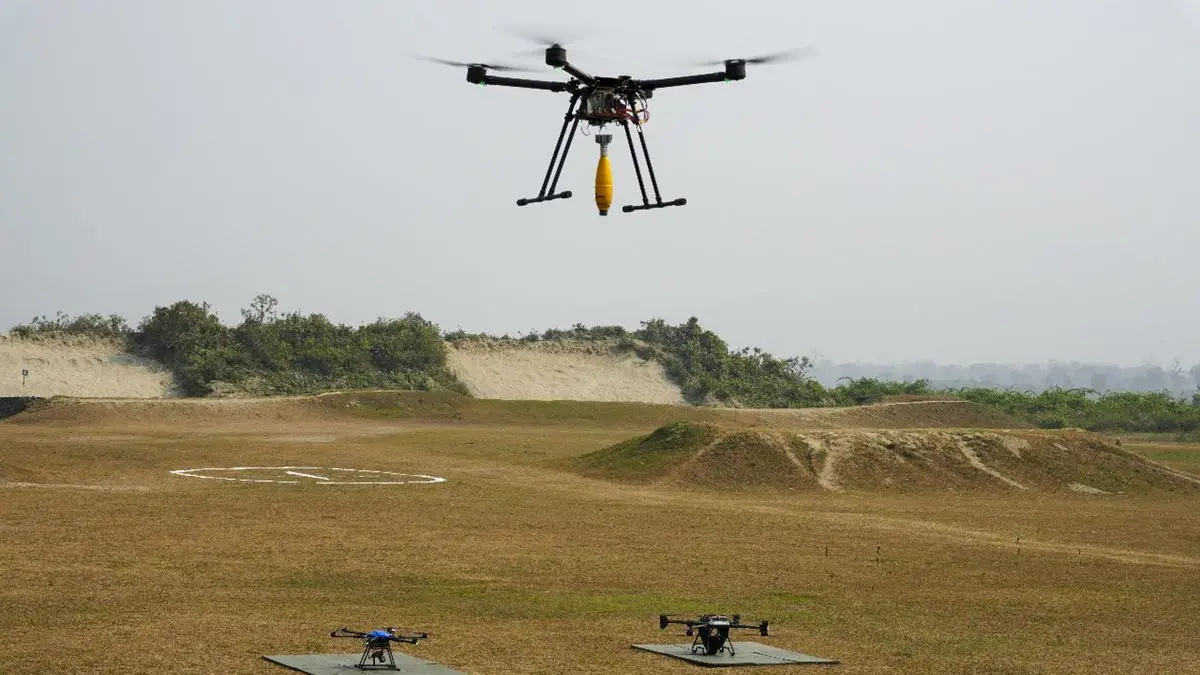
Unmanned Aerial Vehicles (UAVs) played a pivotal role in the asymmetric offensive between the two nations – a trend first observed in the Russia-Ukraine war
| Photo Credit:
PTI
During India’s 4-day offensive targeting terror bases across the Line of Control (LoC), Pakistan employed hundreds of low-cost drones in an asymmetric strategy. These unmanned aerial vehicles (UAVs) served multiple purposes: some acted as decoys to strain India’s military resources, including costly air-defence systems and counter-UAV capabilities; others were used to pinpoint locations of Indian air-defence assets.
India, however, was prepared with a multi-layered air defence system comprising missiles, drones, smart ammunition, and counter-drone technologies, largely indigenous. As Pakistan launched 300-400 drones daily, India’s home-grown military arsenal was heavily utilised, prompting manufacturers to accelerate supplies. The Central government directed missile and drone system providers to fast-track deliveries to counter the enemy’s aerial assault.
Shivaraman Ramaswamy, Co-founder and CTO of deep-tech defence start-up Big Bang Boom Solutions, noted that the conflict highlighted vulnerabilities, emphasising the critical need for large-scale deployment of counter-drone systems.
Accelerators
Since May 7, following the Armed Forces’ strikes on 9 terror camps in Pakistan and Pakistan-occupied Jammu and Kashmir (PoJK), key defence Public Sector Undertakings (PSUs) like BDL and BEL, along with private players such as Tata Advanced Systems Ltd (TASL), L&T, Bharat Forge, and Adani Defence and Aerospace, ramped up production and delivery of platforms, systems, and equipment. Their contributions facilitated the seamless integration of advanced weaponry, enhancing stealth, firepower, and a robust air defence architecture that supported the offensive. Companies worked overtime to meet the urgent demands of the armed forces.
Santosh Balajee, Founder & CEO of Zebu, stated that the recent escalation significantly increased demand for their advanced aerial systems, crucial for national security and tactical preparedness. He added that their teams were working continuously to meet these urgent needs.
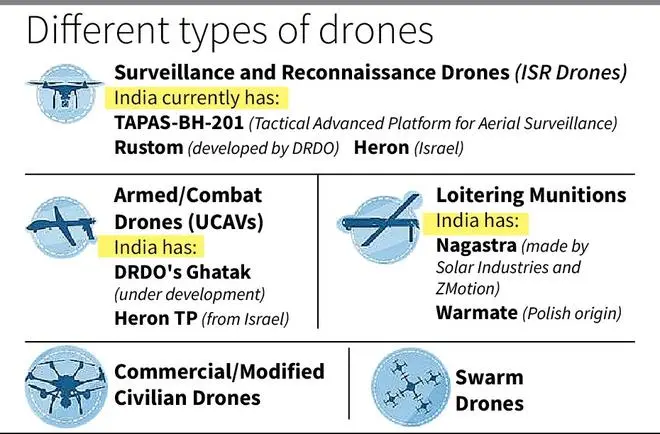
The widely-discussed Akash missile systems’ launchers were jointly developed by L&T and TASL in collaboration with the Defence Research and Development Organisation (DRDO). These include mobile solutions for both the IAF and the Indian Army to intercept medium-range projectiles. L&T sources confirmed the deployment of their Medium Range Surface-to-Air Missile (MRSAM) launchers in the military action. Additionally, TASL’s kinetic systems, including loitering munitions, were deployed for precision strikes. Ammunition for rocket systems was supplied by State-owned Munitions India Ltd and private companies like Solar Industries, sources revealed.
Aerial eyes
UAVs played a pivotal role in the asymmetric offensive between the two nations – a trend first observed in the Russia-Ukraine war and subsequent global conflicts, including the Israel-Hamas conflict.
The strikes on key Pakistani airbases – Nur Khan and Rahim Yar Khan – were facilitated by loitering munitions and kamikaze drones, which effectively located and destroyed high-value targets, including enemy radar and missile systems.
Sources indicated that indigenous companies such as Adani, Sagar Defence Engineering Pvt Ltd, and Idea Forge offered drones with diverse capabilities for surveillance, reconnaissance, and combat. Sources confirmed that multiple platforms were deployed in Operation Sindoor, including Adani Group-owned firm’s Sky Strikers and loitering munition UAV-Launched Precision Guided Missiles (ULPGMs).
Counter-drone systems developed by the DRDO, MSMEs, and start-ups like Chennai-based Big Bang Boom Solutions and Zen Technologies were also employed to neutralise incoming aerial threats.
BEL announced the battlefield success of their indigenously-designed and manufactured Akashteer AD System. “Ground-based defence systems integrated with Akashteer made it hell for Pakistan’s air adventure,” the PSU stated on ‘X’.
At least four companies involved in manufacturing drones and related equipment declined to be identified due to the sensitive nature of their strategic use and deployment at key military locations.
(With inputs from Delhi, Mumbai, Bengaluru and Hyderabad)
Published on May 14, 2025
[ad_2]
Source link


