



[ad_1]

The U.S. move to revoke Harvard’s SEVP certification has alarmed international students—especially from China and India—threatening deportations, shrinking enrollment, and impacting the university’s revenue and global funding.
| Photo Credit:
Nicholas Pfosi
A decision by the US Department of Homeland Security to terminate Harvard University’s student and exchange visitor program (SEVP) certification has sparked concern across the Havard’s international student community.
The Harvard Crimson, the university’s student newspaper, reported that “current international students will need to transfer out of Harvard or risk losing their ability to remain in the United States lawfully” should the decision stand. Harvard has also sued the Trump administration over the issue.
Rising numbers, rising stake
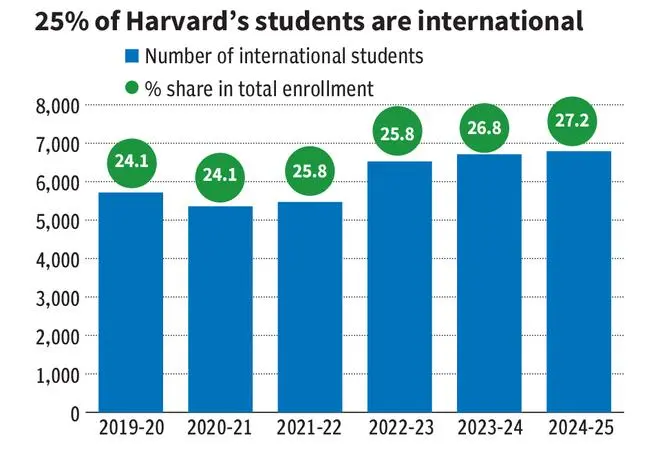
Share of international students in Harvard has been rising steadily from 24.1 per cent in 2019-20 to 27.2 per cent in the 2024-25 academic year. The student base of the university will shrink to that extent, if the order is enforced.
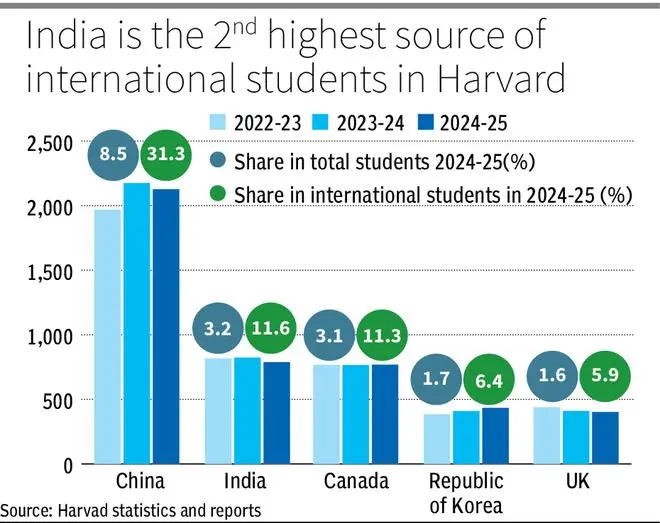
China stands to lose the most since 2,126 students, accounting for 31.3 per cent of all international students in 2024-25, are coming from the country. Indian students form the second-largest cohort with 788 (11.6 per cent of international students). Canada occupies the third position with 769 students (11.3 per cent).
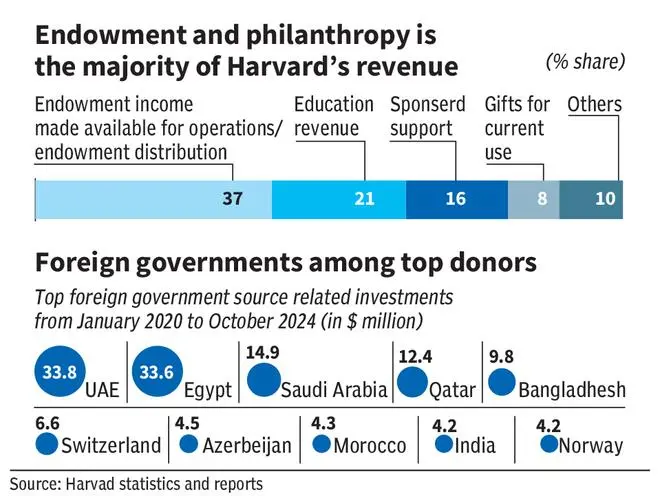
The termination of the SEVP is likely to impact the revenue of the university. Experts said not only will the education revenue move lower, but its endowment funding can also be hit. Endowment income made available for operations accounted for 37 per cent share of the operating revenue of Harvard University in 2024.
Foreign donations
Donations from other countries could dry up amid the stand-off, if international students are not allowed. Foreign governments including the UAE ($33.78 million), Egypt ($33.57 million), Saudi Arabia ($14.93 million) and India ($4.24 million) have donated large sums between January 2020 and October 2024.
Jayaprakash Anand of Career Consultant observes, “If a top-ranking university like Harvard begins to be seen as unstable in terms of visa and enrolment to international students, it may dent its standing in global rankings.”
Akshay Chaturvedi, Founder of Leverage Education, on a social media post on X, said the move is going to have an impact on US’ attractiveness as a talent magnet. He added that if the stand-off continues, the Middle East and European nations may capitalise on the access to high quality talent.
More Like This
Published on May 23, 2025
[ad_2]
Source link


