



[ad_1]
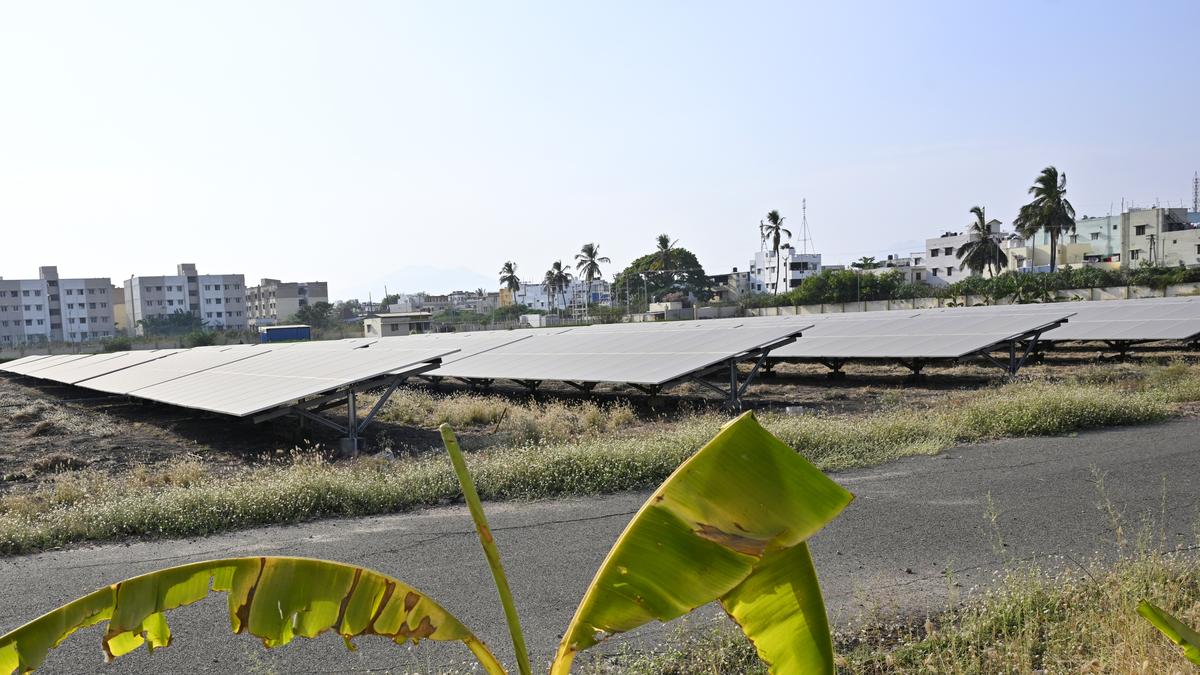
Over 72 per cent of new power capacity under construction is renewable, signalling a decisive shift in India’s energy strategy.
| Photo Credit:
PERIASAMY M
Latest government data presented to the Rajya Sabha in March 2025 reveals that the country’s energy deficit has plummeted to just 0.1 per cent in 2024-25 (up to February 2025) — the lowest in recent history — even as energy demand has risen sharply. Simultaneously, over 72 per cent of new power capacity under construction is renewable, signalling a decisive shift in India’s energy strategy.
In 2021-22, India’s energy requirement stood at 13,79,812 MU, with 5,787 MU unmet (a 0.4 per cent shortfall). Demand rose steadily, peaking at 16,26,132 MU in 2023-24. Despite this growth, the energy shortfall reduced year-on-year — from 0.5 per cent in 2022-23 to 0.3 per cent in 2023-24, and finally to just 1,555 MU (or 0.1 per cent) in the current fiscal year.
Renewable energy leads
Of the 2,13,117.5 megawatts (MW) of power capacity currently under construction, 1,53,920 MW (72.5 per cent) is from renewable sources.
While renewables dominate, thermal power projects contribute 29,900 MW (13.8 per cent) to the capacity under construction. Despite a declining share, thermal remains crucial for providing base-load stability, especially as variable renewable sources like solar and wind expand.
India’s energy strategy is characterised by a diversified mix with hydroelectric projects of 13,997.5 MW (6.5 per cent), offering renewable baseload power. Pumped storage of 8,000 MW (3.7 per cent), vital for managing intermittent renewable supply by storing excess energy. Nuclear energy, 7,300 MW (3.4 per cent) aims providing stable, zero-carbon base-load capacity.
New proposals
In November 2023, Government of India had proposed setting up an additional 80,000 MW coal based capacity by 2031-32. Against this target, coal based capacity of 9,350 MW has already been commissioned in 2023-24 and 2024-25. Contracts for 22,640 MW thermal capacity have been awarded in FY24-25. Further, 33,580 MW of coal and lignite-based candidate capacity has been identified which is at various stages of planning in the country.
As much as 24,225.5 MW of hydro electric projects and 50,760 MW of pumped storage projects are under various stage of planning and targeted to be completed by 2031-32. 7,000 MW of nuclear capacity is under various stages of planning and approval.
70,210 MW of renewable capacity including 46,670 MW of solar, 600 MW of wind and 22,940 MW hybrid power is at various stages of planning and targeted to be completed by 2029-30
Adequate Availability
According to the government, there is adequate availability of power in the country. Present installed generation capacity of the country is 466 GW and government has addressed the critical issue of power deficiency by adding 234 GW of generation capacity since April, 2014 transforming the country from power deficit to power sufficient.
Since 2014, 2,01,088 circuit kilo metres (km) of transmission lines, 7,78,017 MVA of transformation capacity, and 82,790 MW of inter-regional capacity have been added.
More Like This
Published on May 12, 2025
[ad_2]
Source link


