



[ad_1]
Shipping companies are stepping up efforts to make their operations more inclusive through cadet programmes and HR practices that promote the safety and well-being of women sailors.
From improved working conditions to mentorship programmes and tailor-made personal protective equipment (PPE), a host of measures are underway to help increase the number of women seafarers, who currently make up less than two per cent of the global maritime workforce.
In India, too, leading shipping companies are opening up more job opportunities for women, leading to a growth in their numbers.
“Globally, Maersk has increased women seafarer representation from 2.3 per cent in 2022 to 5.9 per cent in 2024. Out of the 650 women seafarers, India leads the way with 350, making it the largest contributor to our growing talent pool,” according to a company statement.
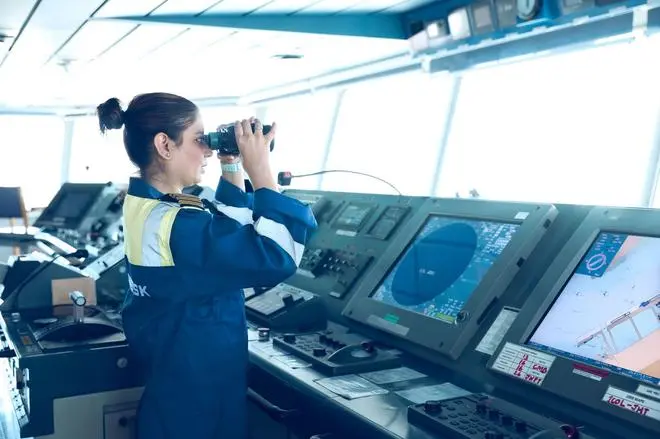
Maersk’s ‘Equal at Sea Initiative’ aims to increase the share of women seafarers to 7 per cent in 2025. A structured pre-joining induction module, On Our Respect Radar (OORR), familiarises cadets with life at sea, interpersonal interactions and professional conduct.
“To create a safer and more comfortable environment onboard, we ensure that at least two women seafarers are assigned to each vessel,” the statement adds.
The Danish shipping company conducts employee engagement surveys twice a year and, over time, based on feedback, it has strengthened its hiring practices to end biases, simplified grievance redressal mechanisms and introduced gender-specific PPE, it says. Gender sensitisation programmes have been designed to train male colleagues in allyship and respectful workplace interactions, it said.
“We have adjusted some physical conditions on ships, which are simply not designed with seafarers of both genders in mind,” says Ralph Juhl, Executive Vice- President (technical) of Hafnia, the world’s largest tanker company.
The adjustments include double changing rooms, male and female toilets, washing and drying rooms, hygiene items and medicine boxes.
Hafnia has six vessels in which women make up half the crew; it has tied up with design firm OSK Design to create gender-sensitive crew accommodation on ships.
Last year, it recruited 49 Indian women seafarers in various roles. “Currently Hafnia employs 522 female seafarers, with India representing 23 per cent of the total,” a company statement said. Two of its three women captains are from India.
However, despite an overall improvement in working conditions, challenges persist. Women sailors face more difficulties in career progression compared to male peers. Long-duration contracts and absence of comprehensive maternity leave policies are areas of concern. Bullying and harassment are among the other serious challenges women crew face, apart from the tough physical conditions associated with sailing the high seas.
“More women are joining the industry but fewer are staying long enough to progress to leadership roles,” Capt Aakriti Barthwal, a Superintendent in Synergy Navis Marine, points out.
Diversity on board
Recognising the prevailing challenges women seafarers face, 12 international shipping companies recently took part in the Diversity@Sea project. The companies committed one vessel each with at least four women sailors for the project. The participating crew were regularly surveyed on issues such as mental health, working conditions and employment challenges for female seafarers.
The findings highlighted focus areas for improvement, such as zero tolerance for abuse and harassment, enhancing work-life balance, and upgrading onboard facilities, including internet and social connectivity.
“You need perseverance to achieve true diversity at sea. But we will not relent because we have talented and ambitious female seafarers who deserve encouragement and support,” says Eva Rodriguez, Director HR (Marine), Bernhard Schulte Shipmanagement (BSM), one of the participating companies.
The company said in a statement that it is working to increase the number of women crew members through a cadet programme. The German company runs six maritime centres worldwide, including one in Kochi, to train seafarers. Currently, BSM’s 500-strong female seafaring workforce includes 65 Indians.
Among Indian companies, the Shipping Corporation of India (SCI) offers initiatives such as age relaxation and fee concession to aspiring female cadets joining its maritime training institute. SCI, which has been recruiting women cadets for two decades, runs a gender sensitisation programme for all its trainees.
The Directorate General of Shipping seeks to increase the number of women workers in the maritime sector under its ‘Sagar Mein Sanman’ programme.
While the number of Indian women seafarers has grown from 345 in FY 2015 to 3,327 in FY 2024, ensuring gender parity at the workplace remains a challenge. The programme also focuses on ensuring fair recruitment practices and showcasing success stories. It will work in four main areas — empowerment, inclusivity, safety and skill development.
Retention strategies
A common lament is that few women make it to leadership roles as retention levels are low. Companies say that, apart from career development programmes, they are also working on ensuring work-life balance. Hafnia offers shorter contracts for women seafarers with children younger than three years. Mental wellness webinars and telemedicine support are arranged, says Maersk. Seafarers receive compassionate sign-offs during personal crises, prioritising their mental and emotional well-being, it added.
More Like This
Published on April 6, 2025
[ad_2]
Source link


